THEPS Newsletter #16: COST, Creativity, Joy and a Small Survey
Your weekly guide to writing better EU projects!
Hello,
When we say we strongly dislike how the National Agencies operate, we mean it. We gave you a broader example last week when we mentioned that they have internal rules even after the submission deadline. Here’s the most recent example.
The National Agency for European Educational Programs and Mobility, aka the NA of North Macedonia, sent out emails requiring all accession forms to be printed in colour (?!), signed and stamped. In 2026. Please stop burdening us with unnecessary bureaucracy!
The most frustrating thing is that no one really allows us to complain because we will immediately be blacklisted (...unofficially, but it’s a real thing). They did give us a form for feedback a few years ago, but the questions were more in line with “no criticism allowed about the Erasmus+ Programme”.
The EU shouldn’t be a place of fear but a palace for transparency and less bureaucracy (among other things, of course). This is why we want to ask you what you think about the way things are. This is a huge opportunity for you, for us and for the EU.
We will begin with a very short survey about this newsletter, it will take you less than 2 minutes to answer our questions. It is 100% anonymous! We mean it. Please help us become better: THEPS Survey.
After you’ve filled in the survey, check out these funding opportunities:
- COST Open Call 2026
- Creativity Pioneers Fund 2026
- Spaces of Culture 2026
- Giving Joy 2026
- Local Funding Opportunities for Lithuania, Belgium, Spain, Luxembourg, Italy, Portugal, and France
- What the Future Holds
COST Open Call 2026
COST (The European Cooperation in Science and Technology) has announced its 2026 Open Call, and if your organisation works in research, innovation, or interdisciplinary collaboration, this is one of the most accessible and impactful funding schemes in Europe.
COST funds research networks, not research projects. These networks are called COST Actions, which are four‑year, open, interdisciplinary collaborations that bring together researchers, innovators, SMEs, NGOs, universities, public authorities, and more.
These COST Actions support:
- networking
- short‑term scientific missions
- training schools
- meetings & workshops
- dissemination
- virtual collaboration tools
COST does not fund research itself, it funds the collaboration ecosystem that makes research stronger.
As read on the official website, “A COST Action has an estimated budget of €150,000 in its first year and on average €180,000 per year for the other three years.” Meaning, a total of ~€690,000 over four years, entirely for networking activities. For 2026, COST will fund up to 80 new Actions, up from 70 last year, resulting in higher success rates.
COST Actions are open to any legal entity, including:
- universities
- research centres
- SMEs & large companies
- NGOs
- public authorities (national, regional, local)
- any organisation recognised under national or international law
In other words, COST is one of the most inclusive programmes in Europe.
Who can propose a new Action?
Your proposal must include:
- at least 7 COST Full or Cooperating Members
- at least 50% from Inclusiveness Target Countries
- at least 40% Young Researchers & Innovators (major change for 2026)
Attention! Each person may only be a proposer once per call!
Deadlines & Timeline
- The call opens: 31 July 2026 (12:00 CEST)
- The call closes: 28 October 2026 (12:00 CET)
- Info Day: 16 June 2026 (10:00–12:00 CEST), highly recommended for newcomers
You can already start building your network and preparing your proposal!
Let’s revise what’s new in 2026, because COST has introduced several important updates:
One: 40% Young Researchers & Innovators
A major shift to support early‑career talent.
Two: One proposal per person
You can only be Main or Secondary Proposer in one proposal.
Three: New e‑COST submission system
Technical Annex is now integrated
Four: Page limits enforced automatically
Streamlined, simpler submission process
Read more here.
Creativity Pioneers Fund 2026
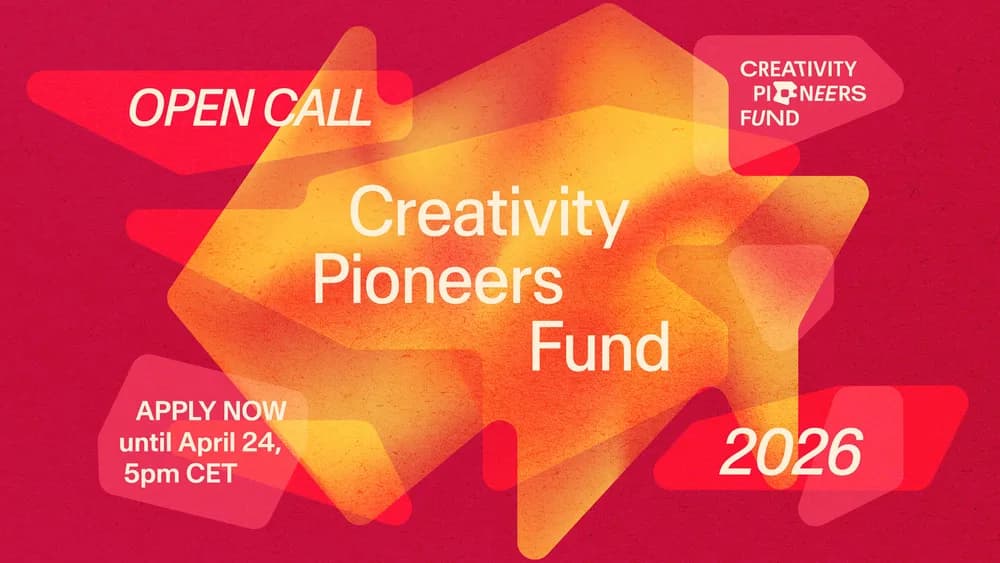
The Moleskine Foundation has opened the Creativity Pioneers Fund 2026, a global micro‑grant programme supporting organisations that use creativity as a tool for social change. This is one of the most accessible, flexible, and values‑driven funding opportunities in the cultural and social‑impact world. The Fund invests in nonprofit organisations worldwide that place creativity at the centre of their mission and use it to drive social transformation, especially for marginalised communities and youth (16-27). It is run by the Moleskine Foundation, with partners including the adidas Foundation, which supports sport‑based creative approaches for gender equity.
This is not “art for art’s sake.” The Fund supports organisations using creativity to tackle real social and environmental challenges, from community empowerment to youth development to systemic change.
Selected organisations receive an unrestricted €5,000 grant, however, the real value is the long‑term collaboration: access to additional funding, mentorship, peer‑to‑peer learning, visibility, and a global network of creative changemakers.
Each selected organisation receives:
- €5,000 unrestricted micro‑grant
- Access to a global network of creative pioneers
- Opportunities for additional funding
- Mentorship and learning programmes
- Peer‑to‑peer exchange
- Increased visibility and international exposure
The grant is intentionally flexible: it can support core costs, programmes, staff time, or organisational development.
The call is open to legally registered nonprofit organisations worldwide. To be eligible, you must:
- Place creativity at the core of your mission
- Work with disadvantaged or marginalised communities
- Primarily engage youth aged 16-27
- Have a bank account in the organisation’s name (no grants to individuals)
Not eligible:
- For‑profit entities
- Political or religious organisations
- Organisations focused only on artistic expression without social impact
- Amateur or sporadic initiatives
- Previous Creativity Pioneers Fund micro‑grant recipients
Deadline: 24 April 2026 at 17:00 CEST
Final decisions: September 2026
Grant agreements & disbursement: By December 2026
Apply here.
Spaces of Culture 2026
EUNIC (EU National Institutes for Culture) has launched the second edition of Spaces of Culture, a major funding opportunity supporting innovative cultural‑relations projects in Sub‑Saharan Africa. This programme is all about co‑creation, dialogue, mutual listening, and shared ownership. The projects can cover a huge range of themes: arts, creative industries, digitalisation, education, gender, heritage, human rights, social inclusion, sports, sustainability, tourism, youth, and more. If it strengthens cultural relations and is co‑created with local partners, it fits.
Spaces of Culture funds contemporary, innovative cultural‑relations projects that bring together African and European partners on equal footing. The goal is to create shared cultural spaces, support local ecosystems, and promote ethical, sustainable collaboration.
The projects must reflect the core principles of cultural relations:
- co‑creation
- dialogue
- mutual listening
- joint capacity‑building
This call requires a triangular partnership, meaning your consortium must include:
- At least three local cultural and/or civil‑society partners in the target Sub‑Saharan African country
- At least three full EUNIC members (or two if no EUNIC cluster exists locally)
- An EU Delegation involved in the project
Budget: Up to €50,000 per project
Attention! There is a minimum 5% co‑funding required from partners. Eligible costs include project activities, preparatory research, feasibility studies, capacity‑building, and more.
Deadlines & Timeline
- Partner engagement deadline: Before 30 April 2026
- This ensures enough time for co‑creation and alignment.
- Application deadline: 21 June 2026 (23:59 CAT)
- Project implementation: 1 September 2026 – 31 August 2027
Your applications must be submitted in English, using the official templates (application form, budget, support letters) and sent to spacesofculture@eunicglobal.eu
Read more here.
Giving Joy 2026
Giving Joy offers $500 microgrants to women (18+) from any country to launch or expand a business, nonprofit, or community project.
The projects must benefit women, girls, or families and be feasible within six months. Only 5-10 grants are awarded per cycle, but the programme is open worldwide and accepts applications in any language that can be Google‑translated.
A great fit for early‑stage, high‑impact ideas.
Learn more here.
Local Funding Opportunities
-> Publishers in Lithuania and abroad can now apply for funding to translate and publish Lithuanian literature: from prose and poetry to children’s books, drama, documentary writing, and graphic novels. The programme supports global dissemination of Lithuanian authors and covers both single‑year and multi‑year publications.
Annual budget: €100,000.
Perfect for publishers wanting to bring Baltic voices to new audiences.
Learn more here.
-> The Indosuez Foundation supports innovative social‑impact projects focused on education, social inclusion, and improving the lives of vulnerable groups. It funds organisations that work with young people, people with disabilities, the elderly, or communities facing social or economic insecurity. Grants typically range from €15,000 to €35,000 per year, awarded for up to two years, and can cover a wide range of project and organisational costs.
This is a local opportunity for organisations based in Belgium, Spain, Luxembourg, Italy, Portugal, or France. Eligible applicants include nonprofits, associations, foundations, and public‑interest institutions with transparent, non‑profit governance. The projects must demonstrate strong social value, measurable impact, and a clear benefit for local communities.
If your organisation works in education or social inclusion within one of the eligible countries, this is a solid mid‑sized funding opportunity with both financial support and access to the Indosuez network.
Read more here.
What the Future Holds
We asked you to participate in the very short survey to help us improve at the beginning of this issue. Here’s the link
again: click here. We will run this survey for the next few weeks, and then the big survey on your thoughts about the EU
funding will hit you like an opportunity you’ve never heard of!
Thank you for joining us and checking out the numerous funding opportunities in the EU (and outside of it).