THEPS Newsletter #18: Short and Sweet
Your weekly guide to writing better EU projects!
Hello,
Spring’s in full bloom, and instead of getting too romantic about it, we’ve decided not to sugarcoat it. The next Erasmus+ open call will end at the beginning of October, and while it’s technically not open yet, you should start writing your projects now. There, we said it.
In the upcoming months, we will share with you statistical data from different countries (related to success rates), important tips and tricks on how to take your projects from 60 points to 85+, the AgoraEU, as well as something huge.
In the meantime, check these out:
- Internal Security Fund (ISF)
- Quick News
- What the Future Holds
Internal Security Fund (ISF)
The European Commission has launched a new call for proposals under the Internal Security Fund (ISF), targeting projects that prevent and counter violent extremism and radicalisation across the EU. With a budget of €10 million, the call supports initiatives that strengthen early detection, improve community resilience, develop prevention tools, and help frontline practitioners respond to evolving trends in radicalisation. In other words, if your organisation works to keep people safe, informed, and far away from extremist rabbit holes, Brussels wants to hear from you.
The call focuses on practical, evidence‑based solutions, which vary from training teachers and social workers to developing digital tools, to supporting local authorities and civil society organisations. Projects can address online or offline radicalisation, youth engagement, community‑based prevention, or capacity‑building for professionals.
And yes, the Commission explicitly encourages cross‑border cooperation, because extremism unfortunately doesn’t stop at the border just because your roaming plan does. (speaking of which, what’s up with the phone bills?!)
This call is open to a wide range of organisations, basically anyone who works on preventing radicalisation and can handle EU‑level project management without crying:
- Public authorities (national, regional, local)
- Law‑enforcement bodies
- Research institutions and universities
- Civil society organisations and NGOs
- Community organisations
- International organisations
- Private entities (if relevant to the topic)
Cross‑border partnerships are strongly encouraged, and proposals must include at least two entities from two different EU Member States.
The Commission is looking for projects that deliver real‑world impact, not just glossy PowerPoints. The eligible activities include:
- Developing early‑warning tools and risk‑assessment methods
- Training for teachers, youth workers, social workers, police, and frontline practitioners
- Community‑based prevention programmes
- Countering online radicalisation and disinformation
- Strengthening cooperation between authorities and civil society
- Supporting families and communities affected by radicalisation
- Research that directly supports prevention and intervention practices
If your project idea includes “raising awareness” as the main activity, you may want to add something more substantial because Brussels has seen enough awareness to last a lifetime. Also, hand to heart, awareness doesn’t cut it anymore, even in the Erasmus+ Programme.
The applications are open now, and the deadline is 22 May 2026. Read more about it here.
Quick News
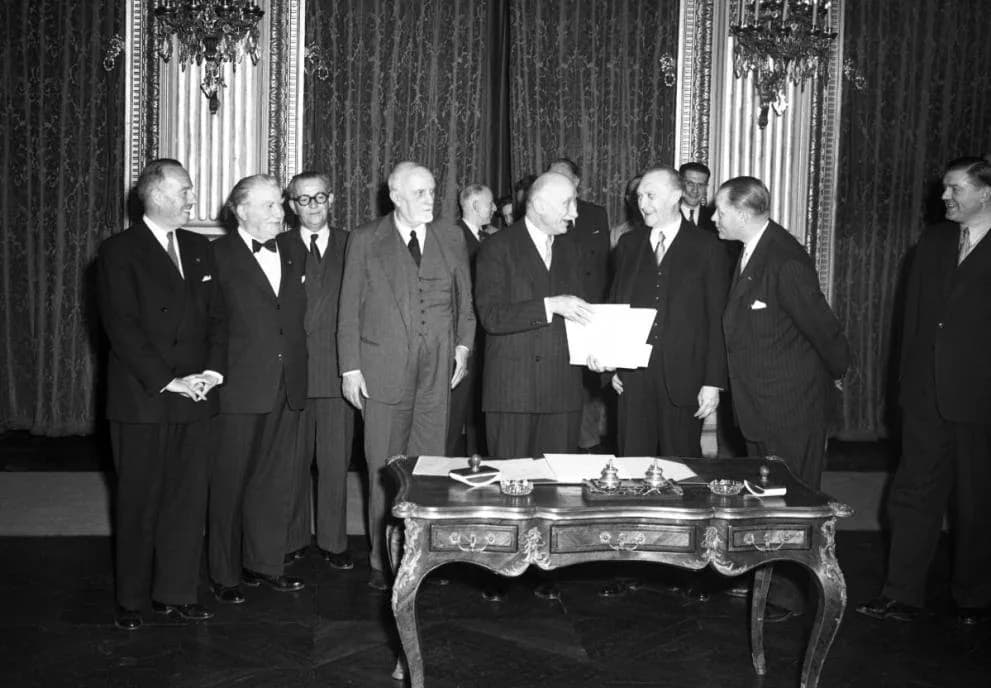
Would you look at these happy men!
The EU marked 75 years since the signing of the Treaty of Paris, the agreement that created the European Coal and Steel Community (ECSC) — the organisation that would eventually evolve into today’s European Union.
Signed on 18 April 1951 by six countries (Belgium, France, Germany, Italy, Luxembourg and the Netherlands), the treaty laid the groundwork for deeper economic integration and later inspired the Treaties of Rome (1957) and Maastricht (1992). It was built on the vision set out in Robert Schuman’s famous 1950 declaration, which argued that pooling coal and steel production would make war between France and Germany “not merely unthinkable, but materially impossible.”
The ECSC’s creation also established the institutional DNA of today’s EU, including the High Authority (now the European Commission), a Parliamentary Assembly, a Council of Ministers, a Court of Justice, and a Consultative Committee. Beyond economics, the treaty symbolised reconciliation after the devastation of World War II and launched a shared experiment in cooperation that would gradually expand into other sectors — ultimately becoming the political union we know today.
So, happy birthday!
What the Future Holds
A friendly reminder about our survey: click here. We will run this survey for the next few weeks, and then the big survey on your thoughts about the EU funding will hit you like an opportunity you’ve never heard of!
Expect a VERY INTERESTING Top 10 list next week!
Thank you for joining us and for checking out the numerous funding opportunities in the EU (and beyond).