THEPS Newsletter #3: Start 2026 Strong: Creative Europe, Digital EU & Smart Partnerships
Your weekly guide to writing better EU projects!
Happy New Year 2026!
Did you have fun during the winter holidays? Maybe you went skiing in the Alps? Maybe you didn’t fight with relatives over politics? Or did you enjoy our favourite tradition coming from Estonia, where people eat seven, nine, or twelve times throughout the last day of the year (those numbers are considered lucky, the person gains the strength of that many men for the coming year, or ensures plentiful food and abundance)?
We are not that superstitious, though. We believe in hard work. And while we know that the beginning of the working week after a long holiday might be frustrating, take some time to read what we’ve prepared for you:
- Creative Europe 2026
- Quick News
- Statistical Data from Malta
- Tips & Tricks
- What the Future Holds
Erasmus+ Mobility Report 2024
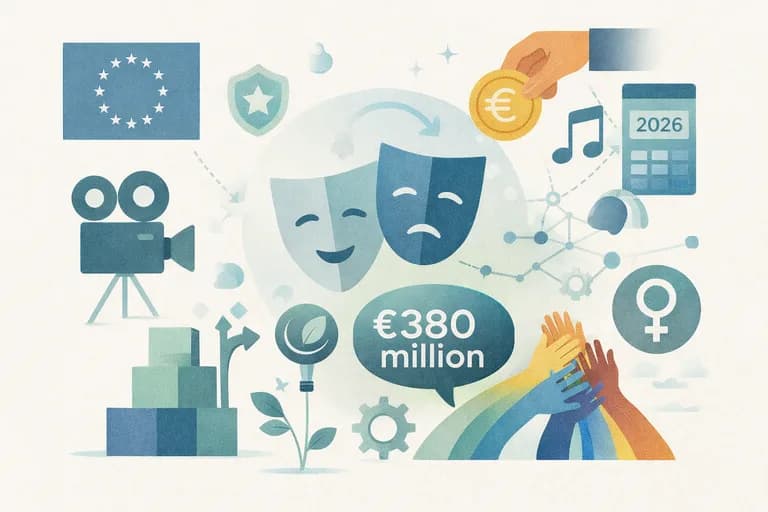
Creative Europe 2026 allocates €380 million for 2026 to support the cultural and creative sectors! The funding will be for projects that reinforce cultural diversity, democracy protection, green transition, digital innovation, resilience, inclusion, and gender equality.
The first 2026 calls are already published on the EU Funding & Tenders Portal. Of course, your organisation should check regularly for application criteria and deadlines. But do you fit the programme’s focus?
Creative Europe 2026 is accessible even to young organisations, but success depends on strong partnerships, alignment with EU priorities, and the ability to co-finance projects. It is open to:
- Cultural and Creative Organisations (museums, theatres, libraries, cultural centres, festivals, galleries, NGOs and associations working in arts, heritage, or creative industries),
- Audiovisual & Media Organisations, which is the MEDIA strand (ONLY for film production companies, distributors, broadcasters, streaming platforms, video game developers and interactive media companies, training providers for audiovisual professionals),
- Educational & Research Institutions (universities, schools, and research centres involved in cultural or media studies, organisations offering training in creative skills),
- Public Authorities & Agencies (ministries of culture, municipalities, and regional cultural offices, public broadcasters and cultural policy institutions) and
- Private Companies & Startups (SMEs in design, fashion, publishing, music, and creative tech, innovative startups working on digital tools for culture and media).
Don’t forget that this is open to EU Member States and associated countries (Norway, Iceland, Western Balkans, Georgia, Ukraine, Tunisia, etc.). However, organisations outside these countries cannot apply directly but may join as partners.
You also need to be careful because, for some calls, one organisation cannot coordinate more than two proposals per strand. Why be greedy? Focus on one excellent project! A project with cross-border partnerships (at least 3 organisations from 3 different countries).
Quick News
One: The ECB illuminated its Frankfurt headquarters with a four‑minute projection welcoming Bulgaria, featuring Bulgarian euro coin designs. The animation included the greeting “Welcome, Bulgaria!” in all the languages of the euro area countries.
Please note that if you are travelling to Bulgaria in January, you can still pay with the Bulgarian lev, however, your change will be given in Euro. The rate is 1 euro = 1.95583 leva.
What does this mean for your projects and the EU? It means smoother participation in EU projects and mobilities.
Two: The European Parliament’s CULT Committee unveiled the Culture Compass in December 2025, a long‑term vision to preserve linguistic diversity, cultural heritage, and strengthen democracy through culture. There will be new funding streams (AgoraEU fund), which will support cross‑border cultural projects in 2026. We’ll update you on this quite soon.
Three: Big wins for digital EU! An interim evaluation of the Digital Europe Programme celebrates some of its achievements:
- The launch of JUPITER, Europe’s first exascale supercomputer.
- Rollout of 169 European Digital Innovation Hubs, supporting over 90,000 organisations.
- Progress on AI factories and Common European Data Spaces.
Does your organisation want to focus more on digitalisation?
Statistical Data from Malta
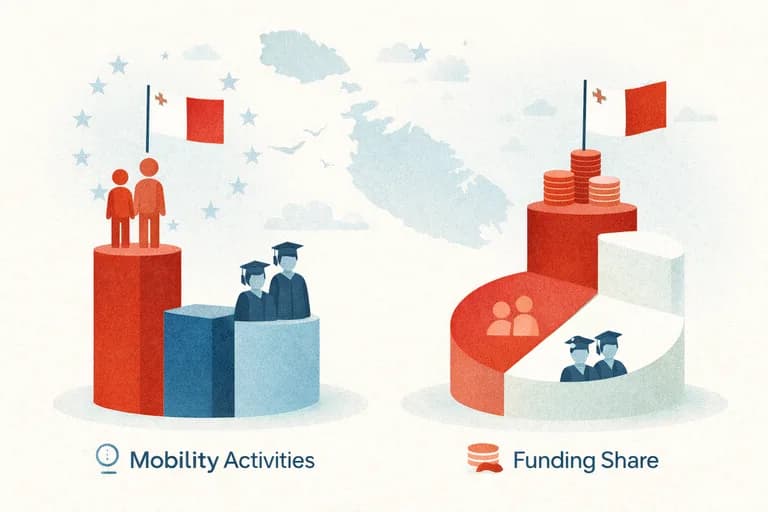
Youth projects had the largest number of mobility activities, while higher education mobility received the largest share of funding. Concentrate on a partner who is experienced!
Finding a trustworthy partner is not an easy job. We are here to help! Coming soon.
Tips & Tricks
A brilliant idea is nothing without a good partnership, especially when it comes to Creative Europe. Partner up early! Join forces with experienced organisations. They know what they are doing, so trust them. Here’s how to do it:
Step 1: Write an outline for your project.
- Start with the name. We all love word play!
- Include the strand. Don’t leave people guessing. Be clear about which Creative Europe strand you’re applying under.
- Always, and we mean this, always include the planned budget and the percentage of self‑funding.
- Introduce yourself. Who are you, what does your organisation do, and why are you applying? Even if you’re sending the outline to old partners, they need to know what you’ve been up to lately. Highlight the expertise of your staff, volunteers, and collaborators.
- In a few paragraphs, explain the problem, your motivation (back it up with statistics!), and how you plan to achieve your objectives.
- Define your dream team. Be honest about the type of organisations you’re looking for and why. Want partners from specific countries with certain experience? Say it. Don’t shy away from this. We’ve all posted calls for partners from certain countries, and yet, some pushy people don’t fit the requirements and insist on being attached. Block them. j/k… or maybe not?
- Projects built on “friendship” alone often struggle, a professional fit matters more.
- Don’t overpromise. Align your ambitions with your resources.
- Take your time. Rushed documents look rushed. Give your outline the care it deserves.
- And finally, be a human about it. Don’t outsource your soul to AI. We can all tell when a text is machine‑made…
Step 2: Send your outline to potential partners as an attachment. Maybe you have a list, maybe you’ll be using the European Commission’s partner search (but honestly, it’s not that easy to obtain the contacts of the partners you actually need, not to mention how much outdated info is out there).
Step 3: In the email, suggest an online call so you can discuss your idea further. This makes you appear very serious about it - you are now ready to work.
What the Future Holds
THEPS is growing fast! Now with over 300 subscribers in a month!
Next week, we’ll explore more pieces of news, something wonderful about Sweden (and it’s not how positive Ace Of Base’s music is) and a “silly” tip about the word directly.
In the meantime, please follow us on social media: LinkedIn.