THEPS Newsletter #37: Now that it’s over, let’s be serious.
Issue #37
12 October 2026
Hello,
Now that the October Erasmus+ deadline is behind us, we can all take a deep breath and invest our time in our current projects, meaningful interactions and learning more about the progress in the European Union.
Even if you’re a new subscriber, you already know that we are not sinless, but we are real. Quite real about partnerships. Today, we’ll be giving you some advice about how to elevate your organisation. You might not agree, but we’re fine with it.
Issue #37 of THEPS focuses on:
- European School Alliances
- textGrain
- Top 10 Ways to Be a Serious Partner
- Statistical Data from Belgium
- The THEPS Platform
- What the Future Holds
European School Alliances
The European School Alliances are a new EU initiative designed to connect schools and education authorities across different countries through stable, long‑term cooperation networks. The resolution on them was adopted on 8 October 2026, and 75% of MEPs supported the initiative (it’s embarrassing, really, that 98 votes against and there were 47 abstentions, even though 443 votes in favour).
Anyway, this is not about student exchanges here and there. They aim to move beyond short exchanges and create deep, structural collaboration between schools. The program aims to reverse underachievement trends in reading, mathematics, science, digital skills, AI, and citizenship.
The idea is that schools will:
- jointly develop teaching methods and materials,
- test approaches that can be transferred across borders,
- create mobility opportunities for pupils and teachers, and
- include disadvantaged schools so they are not left out of European cooperation.
Special attention will be paid to disadvantaged schools.
These alliances should work on:
- basic skills (literacy, numeracy),
- citizenship education & democracy,
- media literacy & critical thinking,
- knowledge of the EU and its values, and
- innovation in teaching.
The European Commission is expected to present a pilot programme in November 2026, with the full initiative planned under the 2028 Erasmus+ work programme.
These Alliances matter for all of us, even if we are not schools. Why? Because we want the schools in our networks to grow. So, if you partner with schools in your area, make sure to forward this email to them.
textGrain
Do you mostly use AI to write your projects? Well, soon everyone will be able to tell that because of textGrain, which is OpenAI's text-watermarking technology.
The important point is that it doesn't insert a visible watermark or alter the text with a special character. It works statistically through word/token selection. With textGrain, a text would still look essentially “normal” to you. The watermark is an invisible statistical pattern in the choices of words/tokens. A detector can then examine a sufficiently long passage and estimate whether that pattern is consistent with an OpenAI-generated text watermark.
It sounds more difficult than it actually is. Remember, we’ve been telling you about the need to polish your project proposals. We’ve advised you to remove words like directly (AI loves that word and adds it in almost every answer) or strong.
Our honest advice is that yes, AI helps us write projects, but if it were that good at writing them, everyone would be funded… You need the polishing touches, the excellent partnership and an innovative idea.
Top 10 Ways to Be a Serious Partner
Here we go! We’re taking a risk with these, but we think tough love sometimes means growth. Please understand that we’ve been guilty of some of these, so we didn’t make them up or mean to attack a partner. Here are the 10 ways to be more serious about being a partner in our very humble opinion:
1. Keep the information about your organisation updated.
If you realise something is wrong only when you receive the accession form for signing, that’s on you, and it slows down everyone’s work. What do you mean there’s a new legal person, or the persons mentioned in the proposal no longer work for your organisation? How is the project writer supposed to know that if you sent them a PIF from 2024?
2. Your PIF should not be a PDF.
PDFs are terrible to copy from and paste into the partner’s information section at Webgate. No one cares how colourful you’ve made it. Use an editable format.
3. Share the project proposal with your partners.
They deserve to know what they’re committing to. No one wants to be surprised by unrealistic target‑group numbers or tasks that don’t match their profile. If you’re cautious, especially with new partners, you don’t have to give them access to the whole thing: the context, a page with their responsibilities, the overall budget and theirs, the timeline and the number of people they will have to engage should suffice. Coordinators must have access to the whole project; this is non-negotiable.
4. Don’t edit for the sake of editing.
If a partner shares a draft, don’t change words just because you think they “sound nicer.” It makes you look unserious. Yes, we said it. Not to mention the character limits. Even adding a word can ruin the whole thing.
5. At official project meals, don’t ask to split the bill.
Pay for your own food and drinks. No one should fund your taste buds. "But it's nice to share a meal." We didn't eat from your plate, did we?
6. Respect dietary requirements.
Speaking of food, the participant list includes a “Dietary requirements” section for a reason. As a host, make sure you accommodate the needs people have indicated.
7. Don’t complain about the workload.
It’s awkward. You signed the contract. Do your job or leave the Erasmus+ Programme.
8. Respect democratic decision‑making.
We live in democratic countries (more or less). If the partnership agrees that something must be done or changed, you do it. You are not above the group even if you’re a coordinator.
9. Finish your work before the deadline.
Not at the last minute. That’s it. No elaboration needed.
10. Be kind.
Everyone makes mistakes. If a partner struggles, there’s usually a logical reason. Offer help… once. If they fail again, don’t work with them in the future. At the end of the day, this is not Europe’s Best Friends Programme. Erasmus+ is about professionalism and growth, not about lazy people building careers on other people’s backs.
What do you think about these rules? Rude? We don't think so. Random? Yes.
Share this email with your colleagues. Let's see what they think. Email us your thoughts, we’d love to hear from you.
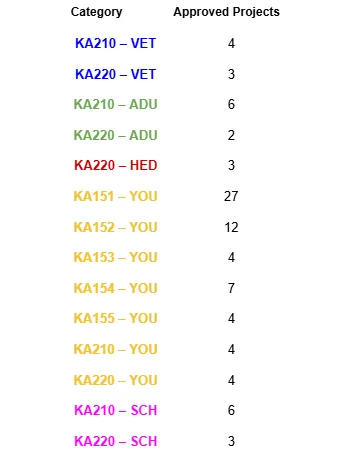
Statistical Data from Belgium
March 2026 Call
The THEPS Platform
The THEPS Platform is growing and growing. We’ve added new features: a favourite button for listings, and now you can manually add previous projects.
We are adding guidelines, which will be available from 19 October. And if you need step-by-step guidance on how to sign up, read the short instructions here.
The March deadline seems too far away, but it’s not. If you have an idea, list it and find your partnership.
What the Future Holds
We don’t know. People we sent to the European Parliament voted against student and teacher mobility, democracy learning and literacy… It’s embarrassing and scary. Please vote. Please educate. Please grow.
Issue #38 will share suggestions about better budgeting, statistical data in Italy, and funding opportunities.
See you next week, THEPSies!