THEPS Newsletter #38: Budget wisely, spend precisely.
Issue #38
19 October 2026
Hello,
Isn’t it annoying when people unfamiliar with the Erasmus+ programme (or any other, really) claim that it’s "useless"? It’s an opportunity that no one else on Earth has: writing educational materials, testing them, sharing them and growing through that particular work in so many countries. The only questionable aspect of the programme is the sustainability of the projects, and we all know it. This is why today’s tip is about the sustainability of your Erasmus+ project.
We also have a brand-new section in the newsletter: selected listings from the THEPS Platform. We will randomly choose project proposals that organisations have published. Maybe you are a potential partner? Go check it out!
Issue #38 of THEPS covers:
- Top 5 Ways to Budget Better
- Tips & Tricks
- Statistical Data for March 2026 from Italy
- THEPS Listing Selection
- What the Future Holds
Top 5 Ways to Budget Better
1. Create a Professional Budget Table
Always prepare a clean, professional spreadsheet. The evaluators appreciate clarity and structure. And don’t forget to attach it!
2. Explain Every Cost in Words (Small‑Scale Projects)
For small‑scale partnerships, describe why each budget item exists. Every activity or task should have a short written justification. For example, a learning‑materials expert's salary, a facilitator fee, catering, venue rental, and a researcher's salary. This shows transparency and helps the evaluators understand your logic.
3. Justify Budget Differences Between Partners
Explain why each organisation’s budget differs. The partner leading an activity can receive slightly more funding, but this also carries more responsibility. Make this clear in writing so reviewers see the fairness and reasoning. After all, you have about 5000 characters to describe the logic of your budgets.
4. Use Working Days for KA220 Projects
For KA220 projects, it’s the easiest to budget using working days. Define categories of staff (trainers, managers, researchers, IT specialists, etc.). You can either:
- set different daily rates per country (to reflect local salaries and living standards), or
- use one equal rate for all partners (to ensure fairness).
Both approaches are valid. Justify your choice clearly.
5. Keep It Transparent and Professional
Whether small‑scale or large‑scale, your budget should read like a story of responsibility and fairness. Clear explanations, consistent logic, and professional formatting make your proposal stronger and easier to trust.
You will soon be able to write your budgets on the THEPS Platform and download a proper file for Webgate.
Tips & Tricks
Easy-peasy, lemon squeezy. Where the lemon is the project website, and the easy-peasy is you writing these numbers in your proposals:
- Small-scale project websites: 3 years after the project’s end
- Large-scale project websites: 5 years after the project’s end
Whether anyone is going to visit them and why are other questions. But the evaluators need to see some kind of online sustainability for your inputs.
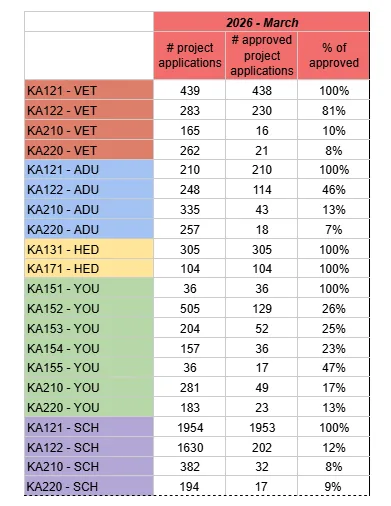
Statistical Data for March 2026 from Italy
THEPS Listing Selection

To fully read to project description and to apply, click here.
What the Future Holds
We are enjoying cups of tea. The rain is drizzling, but we are not depressed that the summer’s gone. Actually, we are more and more determined to educate the people of Europe with our “useless” projects.
Thank you for being a part of this experience. Next week, we will share with you our thoughts on the upcoming EU elections.